Sermon: Community, Congregation, Colony spoken 9/27/2026 by Teri Richards, Certified Lay Speaker, Willow Valley UMC
This week’s reflection was prepared with the help of AI using the transcript from Sunday’s sermon. While this summary captures the main themes, there is no substitute for hearing the full message. If you’d like to listen to the complete sermon, simply click the audio player below.
A few weeks ago, I found myself reading the book of Philippians in nearly every Bible translation I own. I like reading different versions because they help me see familiar passages in new ways. Sometimes a fresh perspective opens a door that I had somehow walked past dozens of times before.
One translation I often enjoy is the Amplified Bible. Instead of sending readers down to footnotes, it places brief explanations and shades of meaning directly into the text. It can be a little distracting at first, but it also slows you down enough to notice things you might otherwise miss.
This week, one phrase from Philippians 2:13 would not leave me alone:
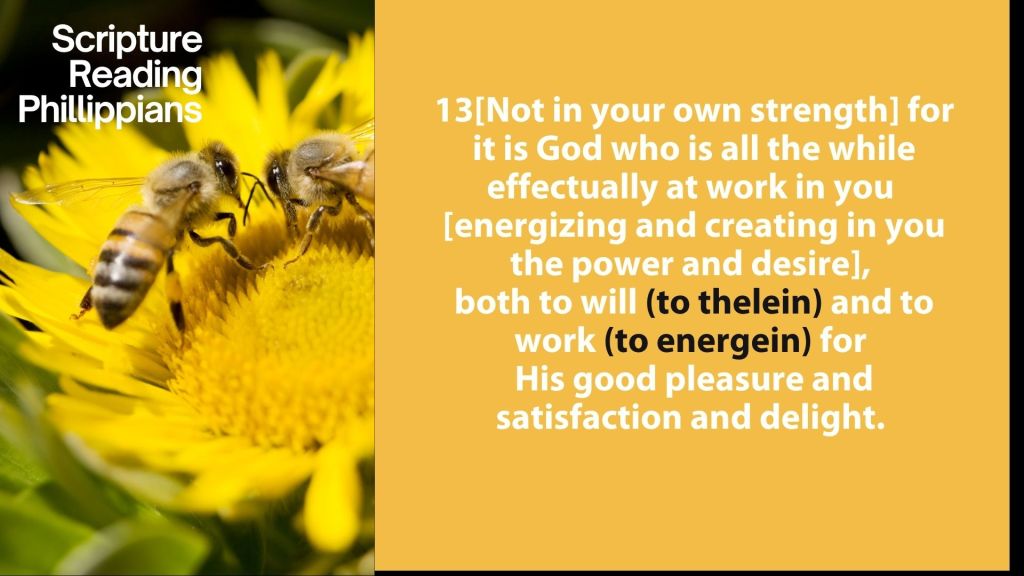
“For it is God who is at work in you, both to will and to work for His good pleasure.”
I found myself digging into the Greek behind those words. “To will” refers to desire, intention, or longing. “To work” refers to action, energy, and accomplishment. Paul is making a remarkable claim. God doesn’t just give us the strength to carry out His purposes. He also shapes the desire within us to pursue them in the first place.
In other words, God supplies both the motivation and the power.
That struck me deeply.
How often do we try to do things entirely in our own strength? I know I do. When I rely only on my own effort, I grow weary. I become discouraged. The work feels heavy. But when God’s desire begins to align with my own, something changes. There is energy. There is purpose. There is life.
As I wrestled with this passage, I found myself thinking about honeybees.
Now, I will be honest. A week ago, I didn’t know very much about honeybees. I knew they were important, and I knew they made honey. Beyond that, my knowledge was pretty limited.
Then I did what many of us do when we become curious about a subject. I went down a YouTube rabbit hole.
Three hours later, I was fascinated.
Honeybee colonies are extraordinary communities. Every bee has a specific role. Young worker bees care for larvae. Later they help build the hive. Eventually they become foragers, gathering nectar and pollen. No single bee does everything, yet every task matters.
The colony thrives because each member contributes according to its purpose.
The more I learned, the more I saw parallels to the church.
Christ is our center, just as the queen is central to the hive. When a colony loses its queen, confusion follows. Likewise, when churches lose sight of Christ and His mission, they lose direction and vitality.
Every member of a congregation has a purpose. Some people nurture and encourage. Others teach. Some organize. Some repair buildings. Some prepare meals. Some quietly send cards, visit neighbors, or pray faithfully behind the scenes.
No role is insignificant.
In many ways, church life resembles a healthy hive. We are designed to work together, each using the gifts God has given us.
Over the past few years, I have watched many churches struggle. The pandemic changed communities everywhere. Attendance patterns shifted. Relationships became strained. People grew isolated.
Yet I also see signs of hope.
People are hungry for connection. They are searching for meaning, purpose, and belonging. Many cannot quite identify what is missing, but they know something is.
The church has something the world desperately needs.
Not because we have all the answers.
Not because we are perfect.
But because we carry the love of Christ.
That love is expressed in a hundred ordinary ways. It shows up in fellowship meals, Bible studies, building projects, worship services, community events, and simple conversations. It appears whenever people gather to care for one another and serve something bigger than themselves.
The challenge before us is not simply maintaining the hive. It is leaving it.
Mature worker bees venture out to gather what the colony needs to flourish. In the same way, the church cannot remain focused only on itself. We are called outward.
That does not mean standing on a street corner with a sign.
It means building relationships.
It means paying attention.
It means noticing the lonely, the hurting, the searching, and the weary.
It means showing up.
Most of all, it means loving people well.
The community around us needs what happens inside our churches. People need belonging. They need hope. They need grace. They need a place where they are known and welcomed.
I believe God is already at work preparing hearts. The question is whether we are willing to join Him.
Paul reminds us that we are not left to do this alone. God provides both the desire and the power. He shapes our hearts and energizes our actions. He equips us for the work He places before us.
When we align ourselves with His will, ministry becomes less about striving and more about participating in what God is already doing.
Perhaps that is the lesson the bees taught me this week.
A thriving hive depends on every member doing their part. A thriving church does too.
And when God’s people are fed by His love, strengthened by His Spirit, and sent into the world with compassion, there is growth.
There is life.
And there is great delight in the heart of God.


Leave a comment